
Custom Zipper Acceptance Criteria: REACH Nickel-Free Brass, Salt Spray
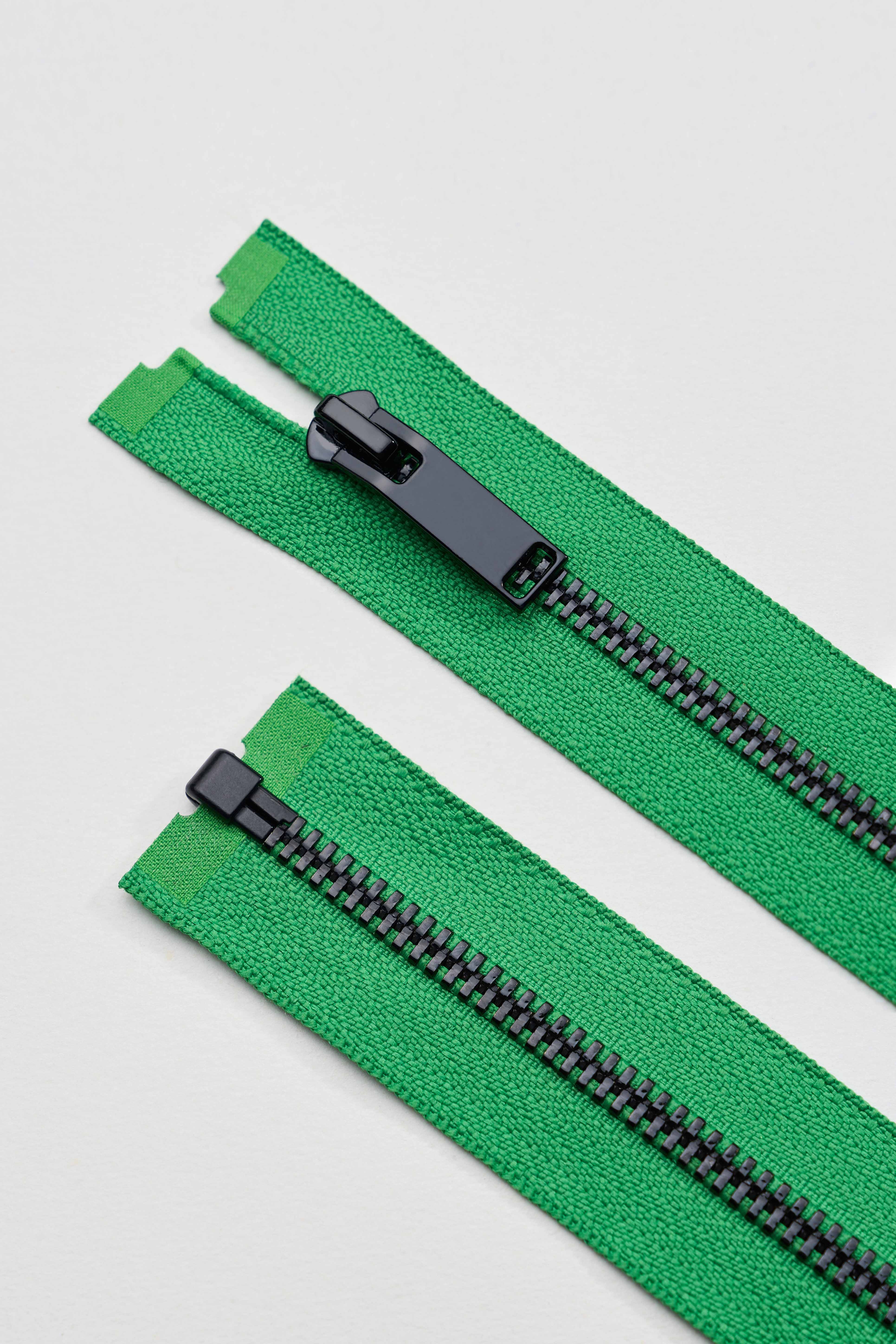
Brass zipper with corn teeth — the line that carries the nickel-free option for EU REACH markets.
Custom zipper compliance is settled by four recorded facts, not by the word "compliant" on a quotation. On the brass and aluminum alloy lines produced by Wenzhou Runhe Garment Accessories Co., Ltd (YAB Zipper), those facts are: a nickel-free brass option that complies with the EU REACH standard, a salt spray test result above 24 hours on both metals, and crosswise tensile strength of 510N for brass and 410N for aluminum alloy. Each value is specific enough to be written into a purchase order as an acceptance criterion — and each one fails in a predictable way when it is written loosely.
This guide addresses buyers at the research and evaluation stage: brand sourcing teams, luggage and footwear developers, and OEM purchasers who have already chosen a zipper type and now need to convert supplier statements into terms a factory can be held to.
Why "Compliant" Fails as an Acceptance Criterion
An acceptance criterion needs five parts: the subject, the method, the threshold, the evidence, and the consequence of failure. A statement such as "REACH compliant" or "corrosion resistant" supplies only the first. It does not say which item, which test, which limit, which document, or what happens to a lot that misses the limit — so it cannot be inspected, disputed or resolved.
Three failures account for most disputes on custom zipper orders:
- The option was never ordered. The nickel-free brass option is an option. An order line that does not name it is not defined by any nickel-free document.
- The certificate proves the wrong thing. An ISO 9001 certificate confirms a quality management system, not the chemical or mechanical performance of a specific shipment.
- The test result travels without its conditions. A duration figure taken away from its test method, finish and evaluated part cannot be compared with anything.
Where Metal Zipper Compliance Pressure Comes From
Compliance questions concentrate on metal zippers because metal is where the regulated chemistry sits. According to Business Research Insights data for 2025, metal zippers held a 31% share of global zipper consumption, and brass together with aluminum represented 67% of metal zipper production. Those are 2025 share observations, not a forecast.
The practical reading is straightforward: if a brand sources metal zippers, the two metals most likely to appear in the order — and therefore in the compliance file — are brass and aluminum alloy. The two lines are also the pair most often compared on weight and cost, which is why a single order may contain both. That makes it useful that both carry the same salt spray benchmark in this range, while differing on tensile strength and on the documentation that applies to each.
The Recorded Benchmarks at a Glance
The table below sets out what the brass and aluminum alloy lines actually record, so that a purchase order can quote the same terms rather than a paraphrase of them.
| Parameter | Brass zipper (item 6887) | Aluminum Alloy zipper (item 6274) |
|---|---|---|
| Material | Brass, polyester | Aluminum |
| Crosswise tensile strength | 510N | 410N |
| Salt spray test | >24 hours | >24 hours |
| Nickel-free / EU REACH | Nickel-free option available; complies with the EU REACH standard | Not addressed by the brass-line nickel-free statement — confirm separately if your specification requires it |
| Surface finishes | Gold, antique brass, gunmetal, nickel silver plating colours | Bright silver, matte silver, black, champagne anodizing |
| Teeth types | Y, Euro, normal, corn | Y, corn, normal, Euro |
| Sizes | #3, #5, #8 | #3, #5, #8 |
| Weight | Reference weight | 35%–50% lighter than brass |
| OEM / ODM | Custom logo slider and puller | Custom logo slider and puller |
The Nickel-Free Brass Option and EU REACH
REACH is the European Union's chemicals regulation. Among its provisions are restrictions on nickel release from articles that come into prolonged contact with the skin — which is why the question reaches zippers on jackets, jeans, footwear and bag closures rather than staying inside a chemistry department.
The brass line is available with a nickel-free option that complies with the EU REACH standard. Two words in that sentence carry the risk: option and available. The nickel-free specification is a selected configuration. If it is not named on the purchase order, the order does not inherit it, and a compliance file built on an earlier sample may describe a product that was not shipped.
What a usable nickel-free statement should contain
- The item and option, named against an identifier — for example brass item 6887, nickel-free option.
- The plating colour or finish actually covered, because the finish is what sits on the surface.
- The market the statement is written for, since the brass nickel-free option is documented as compliant with the EU REACH standard.
- The issue date and issuing party, so the document can be traced and refreshed.
- Confirmation that the statement applies to the ordered lot, not only to a development sample.
One detail deserves separate attention. The brass line's plating colours include gold, antique brass, gunmetal and a colour named nickel silver. Because "nickel silver" is used as a colour name in the range, a buyer who requires the nickel-free option should confirm the requirement against the specific finish on the order line instead of assuming the nickel-free statement covers every colour in the palette. That single check resolves most of the ambiguity that otherwise survives into a purchase order.
The ISO 9001 certificate is not a REACH certificate
The brass item 6887 and the aluminum alloy item 6274 are both covered by an ISO 9001:2015 certification, number 24CN34506232Q, issued by ACM INTERNATIONAL CERTIFICATION LIMITED, with a scope of production and sales of zippers, a global market application, and validity from 11 June 2025 to 29 June 2027.
That certificate tells a buyer that the manufacturing process is governed by a documented quality management system. It does not certify nickel release, salt spray performance or tensile strength. A sourcing file that treats the ISO 9001 copy as evidence of chemical compliance has a gap exactly where a European buyer will look first. The company profile also references OEKO-TEX Standard 100 certification; that too is a company-level credential, useful for supplier qualification, and still not a substitute for a product-specific statement.
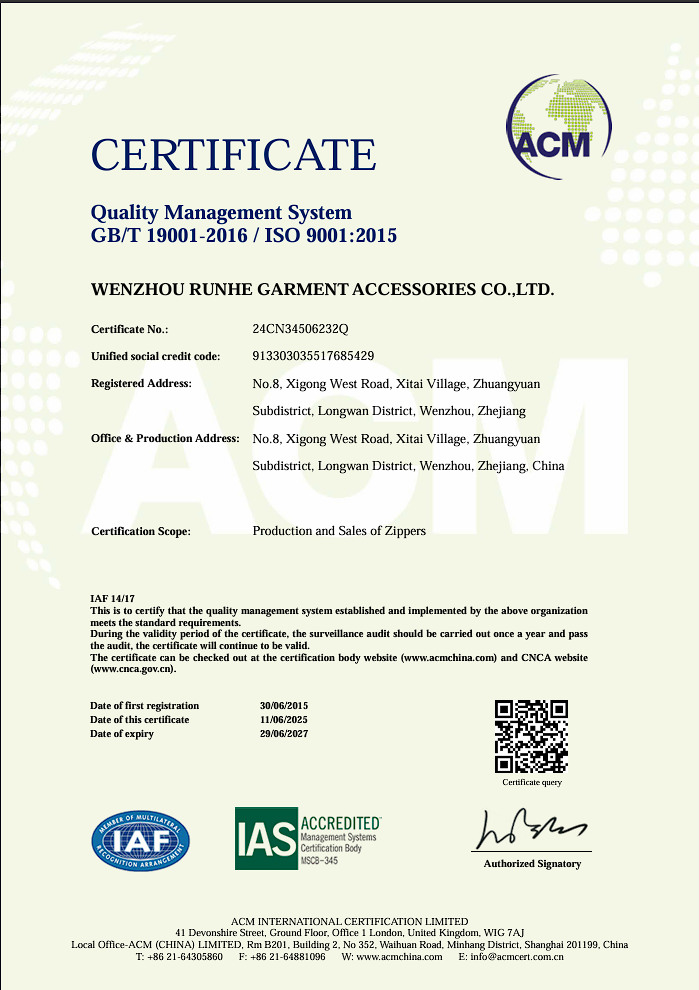
The ISO 9001:2015 certificate covers the quality management system for zipper production and sales — it is a supplier-qualification document, not a product compliance report.
Reading a Salt Spray Result of More Than 24 Hours
Both the brass and the aluminum alloy lines record a salt spray test result of more than 24 hours. For a buyer, that figure is only useful when it is pinned to four conditions: the test method and electrolyte used, the exposure duration recorded, the part that was evaluated, and the criterion that counted as a failure.
"The part that was evaluated" is the condition most often missing. Teeth, slider body, puller and plating colour do not necessarily behave identically in the same chamber, and the aluminum alloy line offers bright silver, matte silver, black and champagne anodizing, while the brass line offers several plating colours. A report covering one finish should not be read as covering the whole palette. Ask which finish and which components were in the chamber, and request the record for the finish you intend to order.
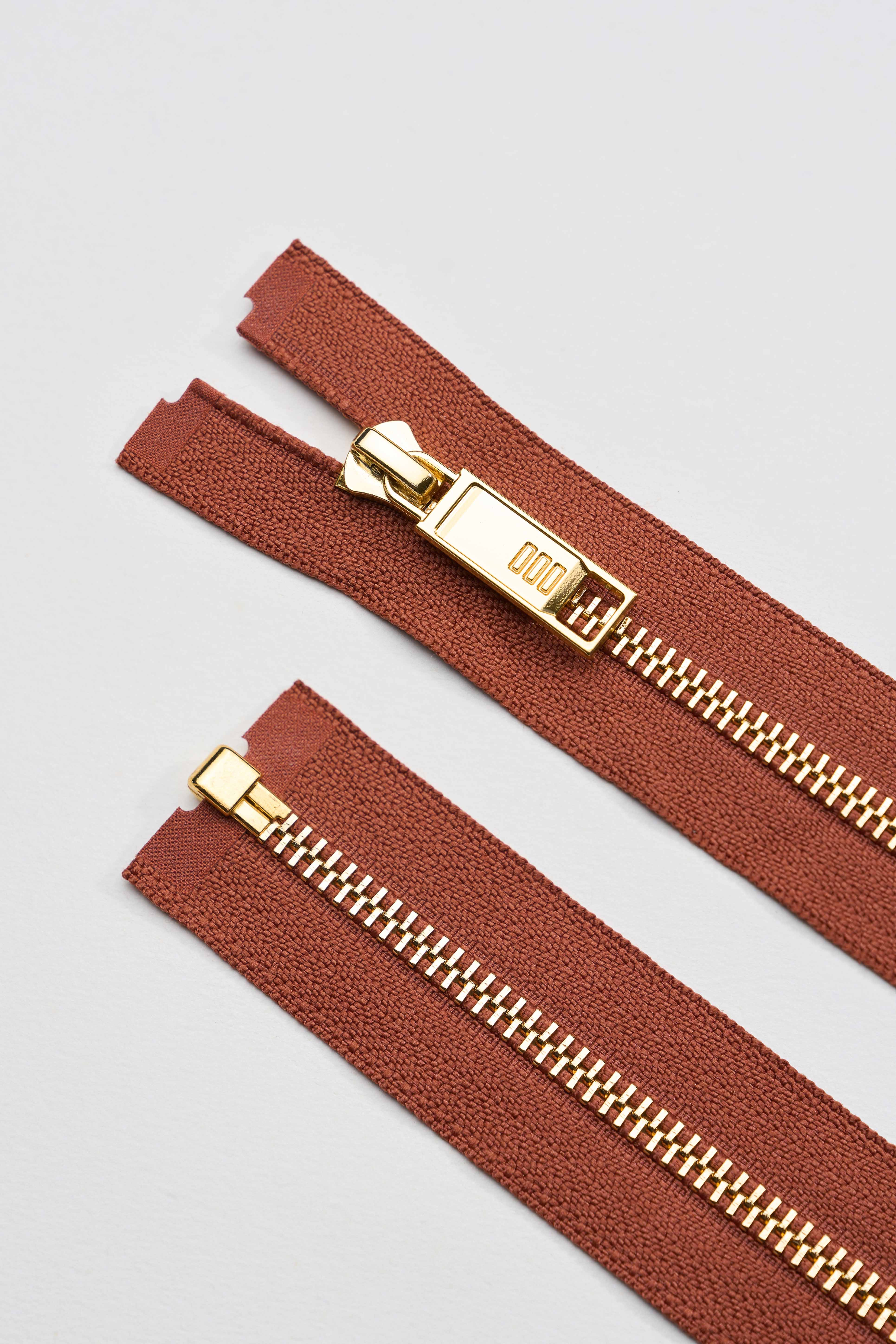
Brass zipper, normal teeth: the recorded benchmarks are >24 hours salt spray and 510N crosswise tensile strength.
Equally important is what the number does not buy. The intended working conditions for these products cover daily indoor use at normal temperature, outdoor use at normal or low temperature including rain and snow, light humidity with slight friction and abrasion, and conventional washing. They are expressly not intended for long-term high-salt seaside exposure or heavy washing with strong acid and alkaline agents. A result above 24 hours therefore supports a verification claim for the tested condition — it is not a marine-grade promise, and writing it into a specification as one would be a mistake the supplier cannot honour.
Crosswise Tensile Strength as a Pass/Fail Line
Crosswise tensile strength is the cleanest acceptance number in a zipper order because it produces a single comparison: measured value against threshold. The recorded benchmarks are 510N for the brass line and 410N for the aluminum alloy line. The 100N difference reflects two different metals, and it matters when a specification is copied from one material to the other — a 510N requirement pasted onto an aluminum alloy order is not a stricter order, it is a mismatched one.
To make the number enforceable, state how it will be checked: the sampling basis, the frequency, and the action taken if a result falls below the threshold — retest of the lot, sorting, or rejection. The declared quality-control practice on custom orders is a 100% pre-shipment test, and it is worth confirming in writing what that inspection covers for your order, since a pre-shipment check and a destructive tensile test are not the same activity.
One further caution applies to both materials. The recorded values are stated for the brass and aluminum alloy lines as specified. If the order changes tooth profile or size — Y, Euro, normal or corn teeth, in #3, #5 or #8 — confirm the applicable strength value for that exact configuration rather than assuming the headline figure transfers unchanged.
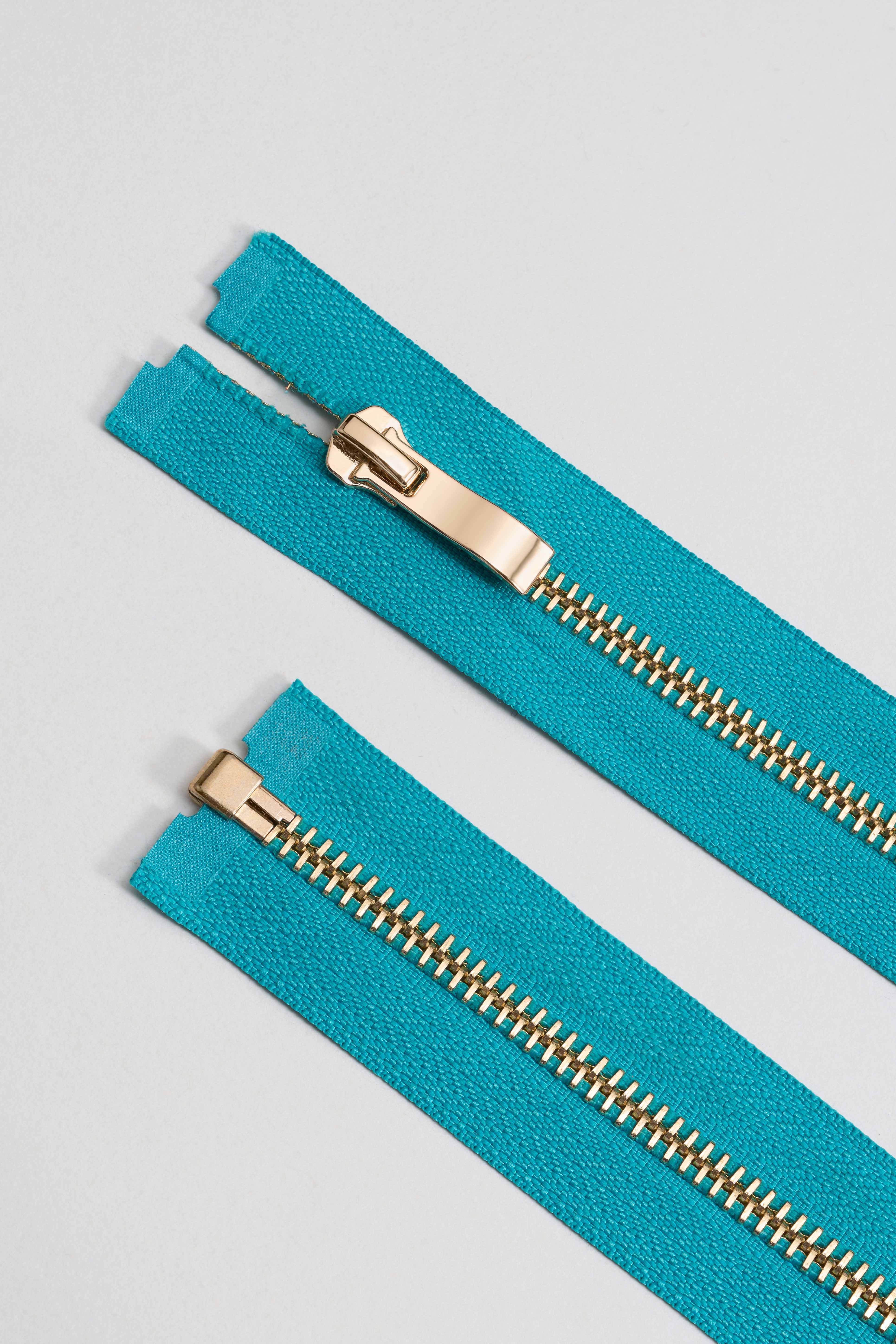
Aluminum alloy zipper, Euro teeth: same >24-hour salt spray result, with 410N crosswise tensile strength as the acceptance benchmark.
Writing the Criteria Into the Purchase Order
The sequence below turns the benchmarks into clauses. It is written for a first bulk order and works equally well as a checklist when an existing specification is being reviewed.
- Name the item and the option. Identify the metal line by its product reference — brass item 6887 or aluminum alloy item 6274 — and state the nickel-free option on the same line if it is required.
- Lock the finish. Write the plating or anodizing colour explicitly (for example bright silver, matte silver, black or champagne anodizing on aluminum; gold, antique brass, gunmetal or nickel silver on brass) and confirm the compliance statement covers that finish.
- State the tensile threshold with its unit. 510N for brass, 410N for aluminum alloy, against the specified configuration.
- State the salt spray requirement as a duration plus conditions. ">24 hours" is the threshold; the test method, electrolyte, evaluated components and failure criterion belong beside it.
- Attach a document list. ISO 9001:2015 certificate 24CN34506232Q, the salt spray and tensile records for the ordered configuration, and the nickel-free EU REACH statement where applicable.
- Define sampling and consequence. Say how many units are checked, at what stage, and what happens to a lot that falls short.
- Require change notification. A new plating colour, a new slider supplier or a changed tooth profile should trigger re-confirmation of the affected documents, not a silent substitution.
Applying the Same Criteria to Four Product Categories
The benchmarks do not change by category, but the emphasis does. Both metal lines are specified for luggage, garment, outdoor goods and footwear, so the same order can serve several product teams — provided each team weights the criteria correctly.
Luggage. Load and repeated cycling dominate, so tensile strength sits at the centre of the specification and the brass line's 510N benchmark is the natural reference. Where a hard-luggage programme is also chasing weight, the aluminum alloy line offers 35%–50% weight reduction against brass and remains above 24 hours on salt spray — a combination that keeps the corrosion requirement intact while the weight target moves.
Garment. Jacket and jeans zippers sit against skin or are handled constantly, which is where the nickel-free brass option connects to EU REACH. For a European garment programme, the compliance question usually precedes the strength question: confirm the option and the finish first, then set the tensile requirement. The aluminum alloy line's lighter weight also suits lighter garment constructions where metal appearance is still wanted.
Outdoor goods. Rain, snow and abrasion belong to the documented working conditions; long-term high-salt seaside exposure does not. Outdoor specifications should therefore quote the >24-hour result honestly and add a separate requirement if the product genuinely targets coastal or salt-water use, rather than stretching the existing figure to cover it.
Footwear. Flexing and continuous handling put a premium on smooth sliding and stable teeth, and small sizes are common. Shoe zippers also sit in the skin-contact category, so the nickel-free question applies here as it does to garments, while the finishing choice should be confirmed against the applicable statement.
Finishing stage: plating colour and slider configuration are fixed here, which is why finish should be named on the purchase order rather than agreed verbally.
What Each Document Proves — and What It Does Not
| Document | What it supports | What it does not establish |
|---|---|---|
| ISO 9001:2015 certificate 24CN34506232Q | A certified quality management system for production and sales of zippers; valid 11 June 2025 – 29 June 2027; global application | Nickel release, salt spray performance or tensile values |
| Nickel-free EU REACH statement (brass) | That the nickel-free brass option complies with the EU REACH standard, for the EU market | Coverage of every plating colour, or of an order line that never named the option |
| Salt spray record, >24 hours | Corrosion performance over the tested duration for the tested components and finish | Marine-grade service, or long-term high-salt and strong acid/alkali washing conditions |
| Crosswise tensile record (510N brass / 410N aluminum alloy) | A strength benchmark for the specified configuration | A different tooth profile, size or slider combination unless re-confirmed |
| OEKO-TEX Standard 100 (company level) | Supplier qualification and textile chemical safety at company level | A product-specific statement for a particular zipper configuration |
Frequently Asked Questions
How does a buyer confirm that the brass zippers delivered are the nickel-free, REACH-compliant option?
Three checks close the loop. First, the purchase order must name the nickel-free option against brass item 6887 and against the specific plating colour being ordered. Second, the supplier's statement must reference the EU REACH standard for that option, with an issue date and issuing party. Third, the pre-shipment record for the shipped lot must tie back to that specification. If the option is absent from the order line, no downstream document can supply it retroactively.
Can brass and aluminum alloy zippers be ordered together with custom logo sliders and pullers?
Yes. Both the brass and the aluminum alloy lines accept a custom logo slider and puller for OEM and ODM orders, and customization extends to zipper length, tape colour, teeth colour, teeth shape, slider shape, slider colour and zipper size. Teeth options cover Y, Euro, normal and corn profiles in sizes #3, #5 and #8, which allows a single programme to combine a heavier brass specification with a lighter aluminum alloy one without splitting suppliers.
Does the aluminum alloy option reduce cost as well as weight?
The aluminum alloy zipper is documented as 35%–50% lighter than the brass equivalent and as competitively priced compared with brass. Weight is stated as a range; cost is stated as a relative position, not a percentage. Buyers building a budget case should request a quotation for the exact configuration — metal, size, tooth profile, finish and slider — rather than applying a general assumption to their own specification.
What should be requested before committing to a bulk order?
Request a sample in the exact metal, tooth profile, size and finish, together with the documentation set: the ISO 9001:2015 certificate, the salt spray and tensile records for the configuration, and the nickel-free EU REACH statement if that option is specified. Custom orders are quoted with a minimum order quantity of 2000 pieces and a production lead time of 7 to 30 days, so the documentation review can run alongside sample approval instead of delaying it.
What are the lead time and pre-shipment controls after an order is placed?
Production lead time is quoted at 7 to 30 days depending on configuration and quantity, with a monthly capacity of 300,000 units. Quality control is declared as a 100% pre-shipment test, and remote technical support is available after delivery. Export markets served include the EU, the US, the Middle East and Southeast Asia. Buyers can download the full company profile and product range from the YAB Zipper company brochure before opening a specification file.
Conclusion: Specify the Number, Not the Adjective
A compliance file is only as strong as the sentence it produces in a purchase order. For custom zipper orders, that sentence can be short: nickel-free brass option compliant with the EU REACH standard, salt spray above 24 hours on both metals, and crosswise tensile strength of 510N for brass or 410N for aluminum alloy — each tied to a named finish, a named test record and a defined consequence for a failed lot.
Wenzhou Runhe Garment Accessories Co., Ltd, which produces the YAB Zipper range, operates a 10,000 m² facility with 150 employees and states a 100% pre-shipment test on custom orders — the operational context behind these benchmarks. The remaining work belongs to the buyer: naming the option, naming the finish, and asking for the record that applies to the order rather than to the sample.

To check these benchmarks against your own specification, request a brass or aluminum alloy sample in the exact finish you intend to order, together with the matching test records. The company profile PDF summarises the full product range.
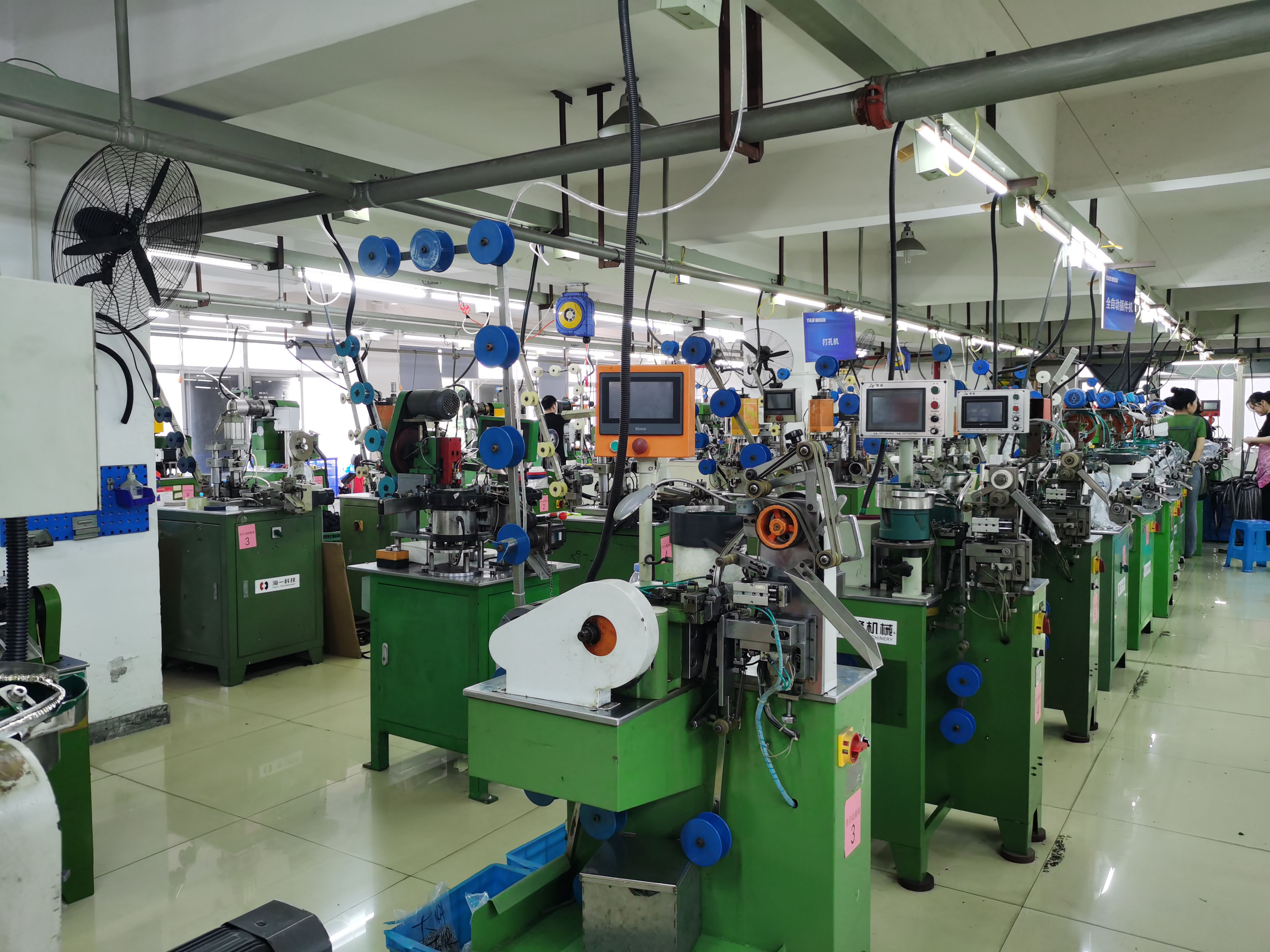
Factory view: sample preparation and document issue are handled at the same site, which keeps the acceptance criteria and the shipped lot aligned.
Have Questions or Need More Details?
Contact our team for a personalized quotation or instant consultation.
Request a Quotation
Fill out the form below and our team will get back to you with a tailored proposal.
WhatsApp Direct Chat
Prefer to chat in real-time? Message us on WhatsApp for instant assistance & quick answers.
- Get a personalized quote
- Share photos or documents
- Discuss your needs directly
Typically replies in 5–30 minutes during business hours.