
Custom Aluminum Alloy Zipper Specs: Luggage to Sportswear
A custom aluminum alloy zipper is specified through four linked decisions, in this order: size (#3, #5 or #8), tooth profile (Y, Corn, Euro or Normal), anodized finish (bright silver, matte silver, black or champagne), and slider or puller customization. For hard luggage, a practical starting point is #5 or #8 with Y or Euro teeth; for backpacks, #5 with Y or Corn teeth; for sportswear, #3 or #5 with Normal or Corn teeth. YAB ZIPPER builds this family on a 410N crosswise tensile strength, a salt spray result above 24 hours, and a weight 35%–50% lower than the equivalent brass zipper, with custom logo sliders and pullers for OEM programs.
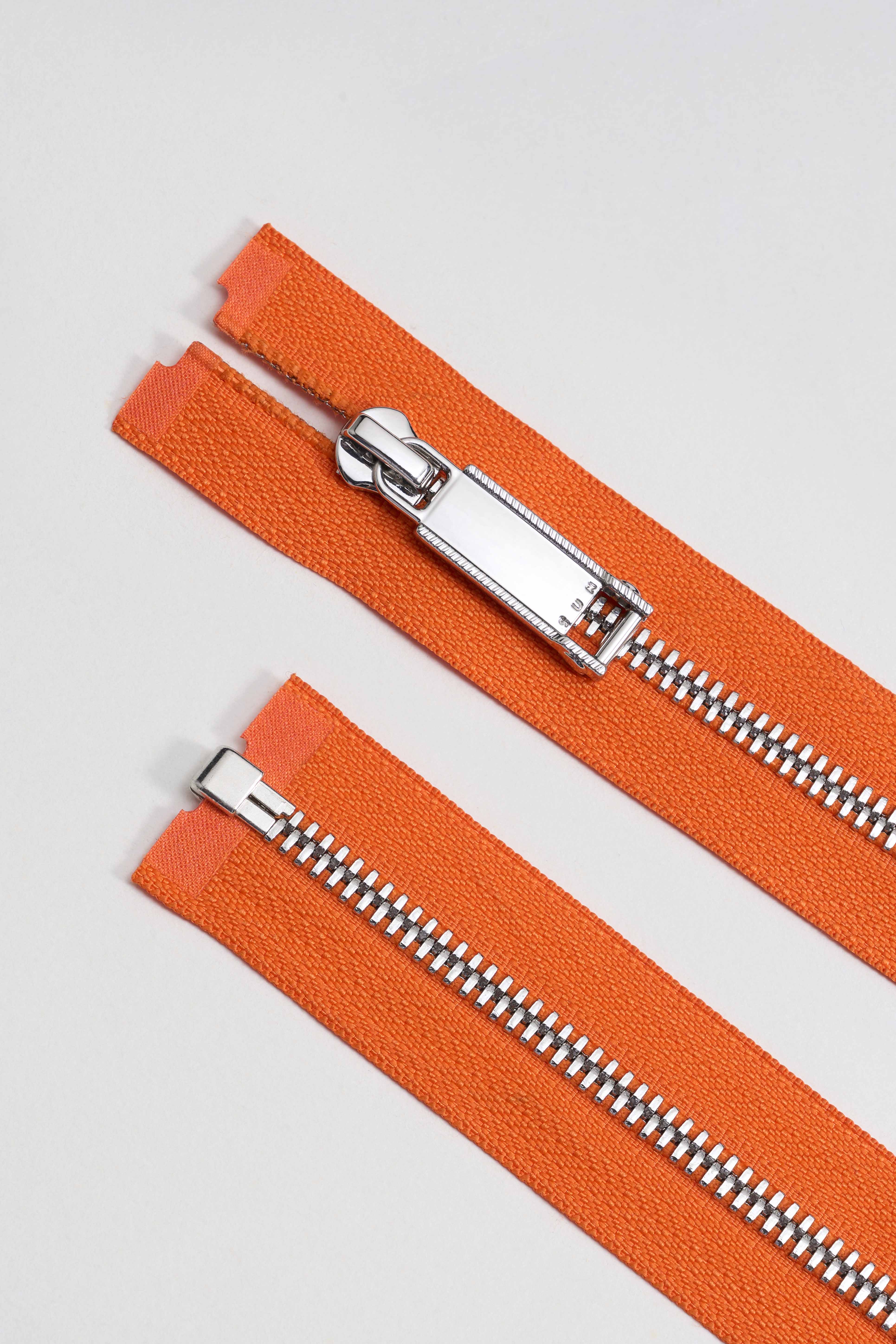
Aluminum alloy zipper, corn teeth profile. The tooth profile, size and finish are chosen per project, not per catalogue page.
The specification problem: one zipper family, four different product realities
An aluminum zipper that works well on a hard-shell suitcase is not automatically the right specification for a running jacket. The difference is not material quality — it is the mechanical and visual job the zipper is asked to do in each finished product.
- Hard luggage uses long chains, wide tape and high pull loads, and the zipper is a visible part of the product's hardware identity.
- Backpacks run the chain over curves and compression seams, then subject it to repeated opening and closing under load.
- Sportswear places the zipper on light fabric where weight, flexibility and colour match dominate the decision.
- Footwear and garment use short chains with tight curvature, where the slider body and puller size can matter more than chain length.
Under-specifying has a predictable failure path: a chain that is too light for the load concentrates stress at the slider and the end stops. Over-specifying has a different cost: a heavy chain on a light garment adds visible bulk and consumes material budget that returns nothing to the wearer. The correct answer for a given project is the smallest, lightest specification that still meets the load, exposure and appearance requirements — and that answer can only be confirmed on a sample built with the actual tape and fabric.
Industry background: where metal sits in the zipper mix
Metal zippers are a minority of global volume but a concentrated share of the applications where appearance and load-bearing matter. According to Business Research Insights, nylon zippers accounted for 46% of total global zipper consumption in 2025, while metal zippers held a 31% share — and within metal production, brass and aluminum together represented 67%. Trade data from the Observatory of Economic Complexity puts global zipper trade (HS 9607) at USD 3.15 billion in 2024, with China accounting for USD 1.52 billion of exports.
For a brand building a luggage, backpack or outerwear line, those figures matter in one specific way: because brass and aluminum together dominate metal production, both are widely available and both are priced against each other. The choice between them is therefore a genuine engineering and commercial decision rather than a sourcing constraint. Aluminum's position inside that decision rests on two documented properties — weight 35%–50% below brass, and a competitive cost relative to brass — while brass retains the higher tensile figure in the same product range.
The aluminum alloy baseline: fixed points before any project choice
YAB ZIPPER is the brand of Wenzhou Runhe Garment Accessories Co., Ltd., a zipper manufacturer based in Wenzhou, China, and the sixth president unit of the Wenzhou Zipper Chamber of Commerce. The company holds ISO 9001 and OEKO-TEX Standard 100 certification, operates a 10,000 m² facility with 150 employees and an annual output of 70,000,000 pieces, and supports OEM, ODM and custom production. Its aluminum alloy zipper line is the subject of this guide, and the following values are fixed across the range before any size, profile or finish is selected.
- Crosswise tensile strength: 410N
- Salt spray test: above 24 hours
- Sliding performance: smooth, manually operated slider
- Weight: 35%–50% lighter than the equivalent brass zipper
- Cost position: competitive compared with brass
- Tooth profiles: Y teeth, Corn teeth, Euro teeth, Normal teeth
- Sizes: #3, #5 and #8 in stock
- Finishes: bright silver, matte silver, black, champagne anodizing
- OEM: custom logo slider and puller accepted
Behind the range, production terms are set at a 2,000-piece minimum order quantity, a 7–30 day lead time, monthly capacity of 300,000 units and 100% pre-shipment testing. Export markets cover the EU, US, Middle East and Southeast Asia, and after-sales support is delivered as remote technical assistance.
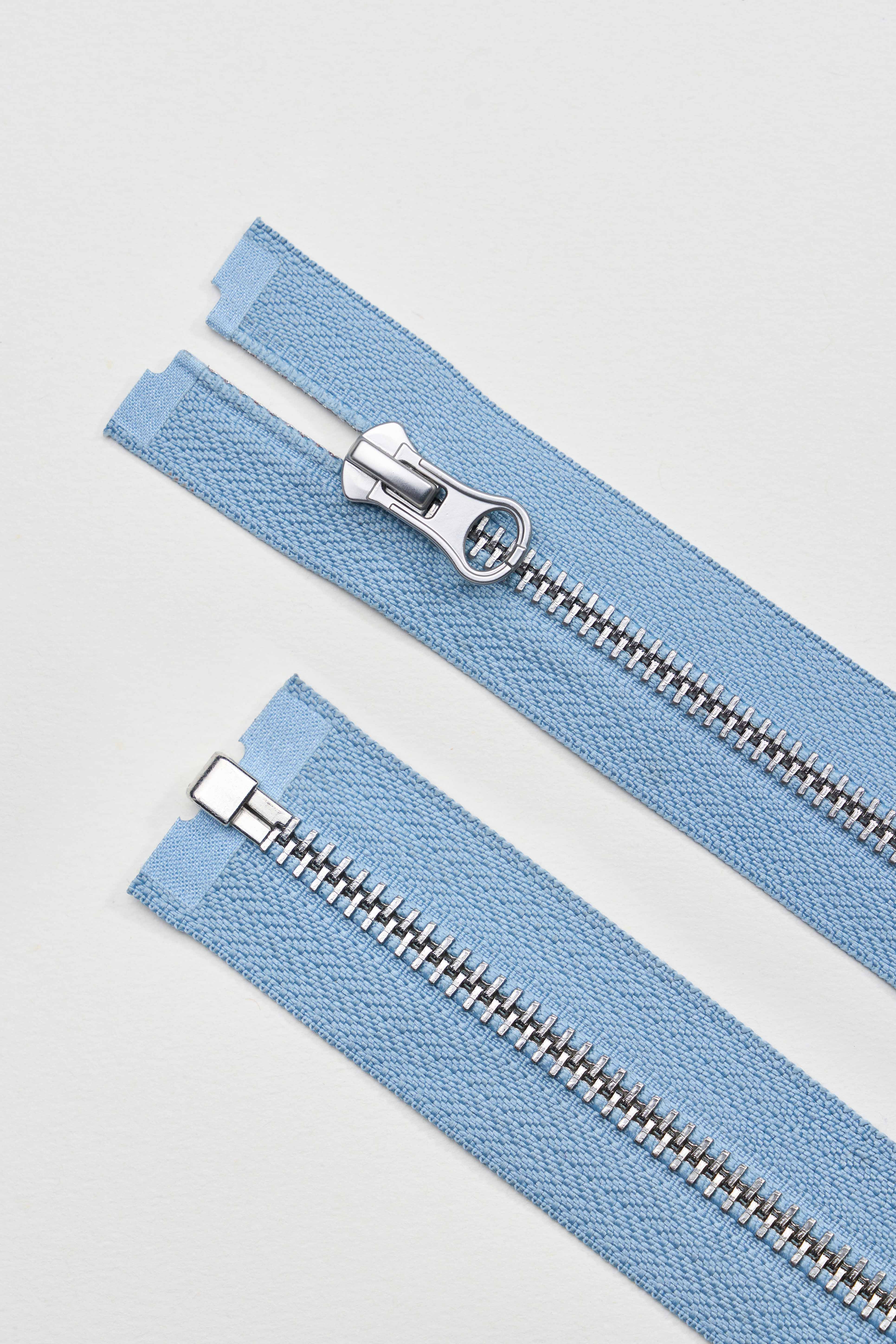
Aluminum alloy zipper, normal teeth. Profile and tape are confirmed together on a physical sample before mass production.
Decision 1: selecting size #3, #5 or #8
Zipper numbering is a width reference, not a length reference. The number indicates the width of the closed teeth in millimetres, so a #5 zipper measures approximately 5 mm across the closed chain. That single relationship explains most of the application logic: wider chains carry more load and read as heavier hardware, narrower chains suit light fabric and short closures.
| Size | Typical starting point for sampling | What to verify before locking the size |
|---|---|---|
| #3 | Sportswear, light garment closures, inner pockets, short decorative chains | Tape width against seam allowance on light fabric; puller size for gloved or cold-weather use |
| #5 | Backpacks and daypacks, mid-weight outerwear, cabin and carry-on luggage | Behaviour on curves and corner radii; slider pull force at the seam junction |
| #8 | Hard luggage main compartments, heavy-duty equipment and travel bags | Full chain length under load; corner geometry; tape width against the frame or flap |
These are starting points for a sampling round, not fixed rules. The same #5 chain can behave differently on a flat panel and on a tight corner, so the size is confirmed on the finished assembly rather than on a flat swatch.
Decision 2: choosing the tooth profile
Four profiles are available in the aluminum line: Y teeth, Corn teeth, Euro teeth and Normal teeth. All four are produced in the same base material and share the line's 410N tensile figure and salt spray result, so the choice is primarily a design and assembly decision — how the chain reads on the finished product, and how it sits against the tape and fabric.
| Profile | Where it is normally considered | Sample check |
|---|---|---|
| Y teeth | Visible luggage and backpack chains where the tooth shape is part of the hardware look | Slide the full assembled chain; inspect tooth alignment at corners |
| Corn teeth | Outerwear, sportswear and bag panels where a rounder tooth appearance is wanted | Confirm the chain closes cleanly over seam bulges |
| Euro teeth | Luggage and premium outerwear where a distinct European-style tooth is specified | Check colour match across tooth, tape and slider |
| Normal teeth | General garment and utility closures where a conventional tooth profile is acceptable | Verify slider travel over the whole chain length without catching |
Because the four profiles are not rated differently in the published specification, the disciplined approach is to request the two or three candidate profiles in the intended size and finish, mount them on the actual tape and fabric, and compare them side by side. That comparison resolves both the visual question and the assembly question in one round.
Decision 3: choosing the anodized finish
The aluminum line is offered in four finishes: bright silver, matte silver, black and champagne anodizing. All four are surface treatments on the same aluminum base, so the finish decision is made after the size and profile are fixed and does not change the underlying mechanical specification.
- Bright silver reads as polished metal and suits luggage and premium outerwear where the zipper is meant to be visible.
- Matte silver reduces reflection and is the calmer option on technical backpacks and sports outerwear.
- Black integrates the chain into dark fabric and is the natural default for performance sportswear and dark luggage shells.
- Champagne anodizing sits between silver and warm metal tones, and is used where the product's hardware runs warm rather than cool.
Two practical checks belong in every finish decision. First, match the finish to the other visible hardware — buckles, D-rings, eyelets and pullers — because a chain that is one shade away from the trim reads as a mismatch at retail. Second, confirm the finish against the project's washing and handling regime, since the finish is a surface layer over the aluminum tooth.
Decision 4: sliders, pullers and tape
Slider and puller customization is where a custom aluminum zipper stops being a component and becomes part of the brand's hardware set. YAB ZIPPER accepts custom logo sliders and pullers for OEM programs, and the customization scope covers zipper length, tape colour, teeth colour, teeth shape, slider shape, slider colour and zipper size.
Slider function deserves equal attention. A self-locking slider automatically locks to prevent the zipper from sliding down on its own, which matters on luggage flaps, backpack front panels and outerwear pockets where a partially open chain would be a defect in use. Manual operation — the user sliding the slider back and forth — applies across the range, and the assembly can be supplied as single open-end, double open-end or closed-end depending on the project.
The matched auxiliary materials for these applications include polyester yarn tape, the garment or bag fabric itself (nylon, cotton, waterproof fabric or leather), sewing machines and luggage sewing machines, sliders, top stops, bottom stops, pins and boxes, and TPU film where a waterproof zipper construction is required.
Step-by-step: building the specification in six steps
- Define the load and cycle profile. Record chain length, the number of open-close cycles expected in a season, whether the chain sits on a flat panel or a corner, and whether the slider must self-lock.
- Fix the size. Start from the table above, then test the candidate size on the real assembly. A #5 that runs cleanly around a backpack's compression curve is worth more than a #8 that binds.
- Choose the tooth profile. Order two or three profiles in the chosen size and finish, mount them, and decide on appearance and slide quality together.
- Set the finish against the hardware. Confirm the chain colour against buckles, rings and pullers under the lighting the product will be sold in, not on a screen.
- Specify slider, puller and tape. Provide logo artwork for the slider or puller, confirm tape colour and width, and state the end type — closed-end, single open-end or double open-end.
- Validate the sample, then lock production terms. Approve the physical sample, then confirm MOQ, lead time and inspection terms in writing against that approved sample.
Scenario map: matching specifications to the project
Hard luggage
Hard luggage puts the highest demands on chain length and load, so the main compartment normally starts at #5 or #8. The aluminum advantage is most visible here: at 35%–50% below the weight of brass, the zipper contributes to a lighter finished case rather than adding to it. Salt spray performance above 24 hours supports the transport and storage exposure a suitcase meets, while the bright silver or champagne finish keeps the hardware consistent with the shell trim. Where a project specifies IP66 waterproofing, IK08 impact resistance or anti-theft slider design, those are project requirements to be quoted and confirmed — they are not automatic properties of every aluminum chain.
Backpacks
Backpacks combine curved seams with frequent, loaded use. A #5 chain with Y or Corn teeth is the usual starting point, in matte silver or black. Two details drive satisfaction more than the headline specification: the self-locking slider, which stops the chain creeping open under load, and the behaviour of the chain over the curve where the panel meets the side. Both are settled on a sample, not in a specification sheet.
Sportswear
Sportswear is where the weight and cost arguments convert most directly. A #3 or #5 chain in black or matte silver keeps the closure visually quiet on light fabric, and the reduced weight against brass supports the overall garment weight target. Specify the washing regime explicitly, because the aluminum line is built for conventional washing and daily use rather than for repeated heavy washing with strong acid or alkali agents.
Footwear and garment
Footwear and garment programs use short chains on tight curvature — boot and shoe zippers, jacket zippers and casual coat fronts. Here the slider body and puller size often matter more than the chain specification, because the user is working the slider with cold hands or through a glove. The application environment for these products is daily indoor use at normal temperature, with outdoor use at normal or low temperature including rain and snow.
Where brass still leads the brief
Some briefs are written around brass from the start. The brass line is positioned for leather bags, jeans, outdoor luggage and premium apparel, carries a 510N crosswise tensile strength, and offers a nickel-free option compliant with EU REACH. A jeans zipper or a leather bag chain is usually a brass decision; a lightweight sportswear or cabin luggage chain is usually an aluminum one. Both run the same four tooth profiles and the same #3, #5 and #8 sizes, which is what makes a mid-project switch practical.
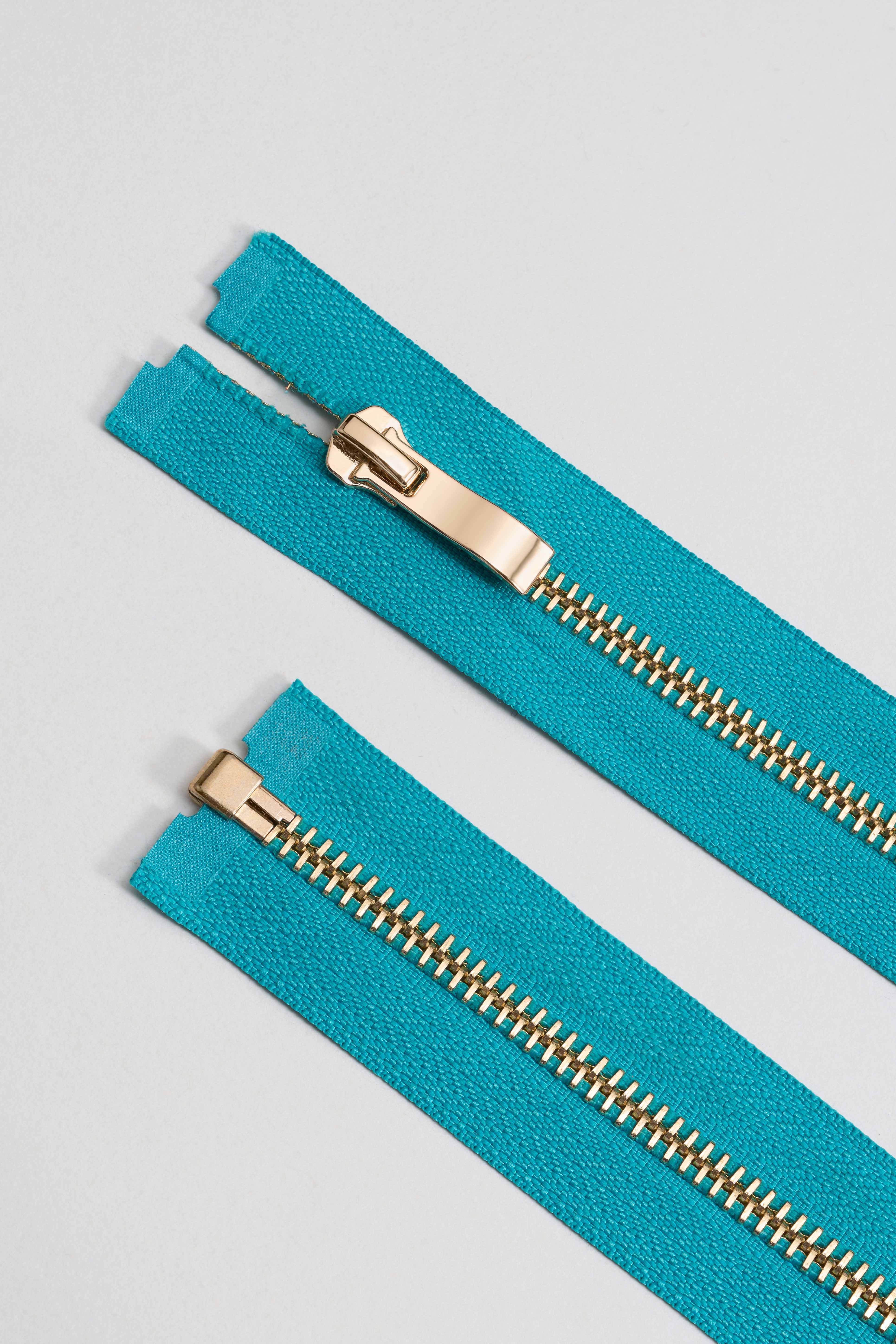
Aluminum alloy zipper, euro teeth. Profile, size and finish are validated together on the finished assembly.
Aluminum alloy vs brass: the comparison that decides the line
| Dimension | Aluminum alloy zipper | Brass zipper |
|---|---|---|
| Crosswise tensile strength | 410N | 510N |
| Weight | 35%–50% lighter than brass | Reference weight |
| Salt spray test | Above 24 hours | Above 24 hours |
| Sliding performance | Smooth | Smooth |
| Cost position | Competitive compared with brass | Reference cost |
| Tooth profiles | Y, Corn, Euro, Normal | Y, Corn, Euro, Normal |
| Sizes | #3, #5, #8 | #3, #5, #8 |
| Finish options | Bright silver, matte silver, black, champagne anodizing | Gold, antique brass, gunmetal, nickel silver; nickel-free option for EU REACH |
| Typical fit | Hard luggage, backpacks, sportswear | Leather bags, jeans, outdoor luggage, premium apparel |
Read the table as a trade, not a ranking. Brass offers the higher tensile figure; aluminum offers the lower weight and the lower cost position, with the same salt spray result and the same profile and size coverage. A project whose pull-load requirement sits comfortably inside the aluminum rating gains weight and cost by choosing aluminum. A project whose load sits near the brass rating should stay with brass, because deleting a number from the specification does not remove the load from the product.
Limits and verification: what the specification does not promise
The 410N tensile figure and the salt spray result above 24 hours are documented properties of the aluminum line, and both should travel with the specification into the purchase order. Neither is a blanket guarantee of performance in every environment. The documented application envelope covers daily indoor use at normal temperature and outdoor use at normal or low temperature including rain and snow, and it excludes long-term exposure in high-salt seaside conditions and heavy washing with strong acid or alkali agents.
Three verification steps belong in every project before mass production begins. First, approve a physical sample built with the actual tape and fabric, not a flat swatch. Second, confirm any project-specific requirement — waterproof rating, impact resistance, anti-theft slider function — as a quoted and tested item rather than an assumed feature. Third, rely on pre-shipment inspection as a control, not as a substitute for your own sample approval; YAB ZIPPER runs 100% pre-shipment testing, and that test verifies the agreed specification rather than defining it.
Case evidence: a four-year outerwear program in France and Spain
An overseas fast-fashion garment brand supplying France and Spain moved spring and autumn lightweight windbreakers and casual coats onto aluminum alloy zippers, in a program with a recorded zipper purchase value of 10,000,000 and four years of continuous cooperation. The reported outcomes for that program were a 38% reduction in total garment weight, a 59% reduction in material procurement cost against the original brass zippers, a reciprocating sliding performance that met the industry standard with a defective complaint rate below 0.3%, and OEKO-TEX certification supporting EU customs clearance.
Those results describe one program with one product mix and one set of commercial terms. They illustrate what the weight and cost difference between aluminum and brass can do for a light outerwear line; they are not a forecast for a different product category, load profile or order volume. The transferable part is the method: define the load, test the sample, then commit the line.
FAQ
Custom zipper manufacturer for jacket production: what should a jacket brand check?
Check four things. First, material coverage — YAB ZIPPER produces copper, aluminum, resin and nylon zipper lines, so a jacket program can be quoted in the material the design actually calls for. Second, customization scope: length, tape colour, teeth colour, teeth shape, slider shape, slider colour and size. Third, commercial terms: a 2,000-piece MOQ and a 7–30 day lead time. Fourth, quality control and support: 100% pre-shipment testing and remote technical support after delivery.
Which aluminum zipper size should a hard luggage project start with?
Start at #5 for cabin and carry-on cases and #8 for main compartments on larger cases, then confirm on the assembled shell. Size refers to the closed teeth width in millimetres, so a #5 chain measures roughly 5 mm across the closed teeth and a #8 is wider and heavier. The deciding test is how the chain runs around the case corner under load, not the number on the drawing.
Is a 410N aluminum zipper strong enough for a loaded backpack?
The aluminum line is rated at 410N crosswise tensile strength, and backpacks are one of its listed applications, typically in #5 with Y or Corn teeth. Whether 410N is sufficient depends on the load your design puts through the chain and on the corner geometry. Where a brief sits close to that rating, the brass line at 510N is the documented higher-tensile option in the same sizes and profiles.
Will an anodized aluminum zipper survive rain and regular washing?
The line carries a salt spray result above 24 hours and is specified for outdoor use at normal or low temperature including rain and snow, plus conventional washing. It is not specified for long-term high-salt seaside exposure or for heavy washing with strong acid or alkali agents. If your product is sold into those conditions, raise it at the specification stage rather than after the sample is approved.
Which finishes are available, and how do I match black hardware?
Four finishes are offered: bright silver, matte silver, black and champagne anodizing. For black shells, trims and technical fabric, black is the direct match; matte silver is the usual choice for mixed-metal designs that should not look polished. Always compare the chain against the buckles, rings and pullers on a physical sample, because finish matching on screen is unreliable.
What are the MOQ, lead time and logo options for a custom aluminum zipper?
The minimum order quantity is 2,000 pieces, lead time runs 7–30 days, and monthly capacity is 300,000 units. Custom logo sliders and pullers are accepted for OEM programs, and full customization covers zipper length, tape colour, teeth colour, teeth shape, slider shape, slider colour and size. The normal next step is to request a sample in your chosen size, profile and finish, approve it physically, and then confirm production dates against that approved sample.
Conclusion
Specifying a custom aluminum alloy zipper is a sequence, not a single choice. Fix the size against the load and geometry, choose the tooth profile on a mounted sample, set the finish against the rest of the hardware, then define the slider, puller and tape. The aluminum platform supports that sequence with a 410N crosswise tensile strength, a salt spray result above 24 hours, smooth manual sliding, a self-locking slider option, 35%–50% weight saving against brass, and a competitive cost position — with the same four tooth profiles and three sizes as the brass line, which keeps a mid-project material switch practical.

YAB ZIPPER, the brand of Wenzhou Runhe Garment Accessories Co., Ltd. — company profile available for download.
YAB ZIPPER (Wenzhou Runhe Garment Accessories Co., Ltd.) supplies aluminum alloy, brass, resin and nylon zipper lines from Wenzhou, China, with OEM and ODM support, 100% pre-shipment testing and remote technical support. For projects in evaluation, the fastest route to a decision is a physical sample in your intended size, tooth profile and finish. You can review the company background at www.cnyab.com and download the YAB ZIPPER company profile (PDF) before requesting a quotation.
Have Questions or Need More Details?
Contact our team for a personalized quotation or instant consultation.
Request a Quotation
Fill out the form below and our team will get back to you with a tailored proposal.
WhatsApp Direct Chat
Prefer to chat in real-time? Message us on WhatsApp for instant assistance & quick answers.
- Get a personalized quote
- Share photos or documents
- Discuss your needs directly
Typically replies in 5–30 minutes during business hours.