
Nickel-Free Brass Custom Zippers for EU REACH Compliance
For a custom zipper order that ships into the European Union, the deciding question is rarely which zipper looks best. It is whether the metal that sits against skin can be documented as nickel-free, and whether the performance behind that claim can be measured. YAB ZIPPER, the export brand of Wenzhou Runhe Garment Accessories Co., Ltd., produces custom zippers with a nickel-free brass option for EU-bound programs. The brass line is documented at a crosswise tensile strength of 510N, a salt spray test result above 24 hours, and standard availability in sizes #3, #5 and #8.
This guide is written for buyers who are already evaluating suppliers rather than discovering the category. It sets out what “nickel-free” should mean on a purchase order, how the brass option compares with aluminum alloy on the same order sheet, when each material is the better fit for leather bags, jeans, outdoor luggage or premium apparel, and how OEM logo slider and puller customization fits inside a compliance conversation instead of sitting outside it.
Problem Definition: Compliance Claims Are Easy, Documents Are Not
Almost every zipper quotation directed at the European market carries the words REACH compliant or nickel-free. Both phrases describe an outcome, not a specification. A zipper is an assembly: teeth, tape, slider, puller, top stop and bottom stop. The parts that most often come into prolonged contact with skin on a finished garment or bag are the slider and the puller, so these are the components a buyer should ask to be named in writing rather than assumed from the words metal zipper.
A blanket claim that the zipper is nickel-free leaves three questions unanswered. First, which components were changed? Second, which finish replaced the nickel-bearing one? Third, which document supports the statement if a retail compliance team or a customs officer asks for it? For a buyer in the Evaluation stage, an unanswerable question is a risk that lands late in production, when tooling has already been approved and the sample has already been signed off.
The practical fix is to convert the compliance claim into a short, checkable specification with three parts: the list of components covered by the nickel-free requirement, the measurable performance values attached to the order, and the certificates that exist independently of the order. Everything else in this guide is an extension of that framework.
Industry Background: Where Metal Zippers Sit in a Growing Market
Documentation requirements are rising with the category itself. Market Research Future values the global zipper market at USD 17.39 billion in 2024 and projects USD 36.73 billion by 2034, a 7.8% CAGR across 2025 to 2034. Material choice inside that volume is not evenly distributed: Business Research Insights reports that nylon zippers accounted for 46% of global zipper consumption in 2025, while metal zippers held 31% of the market, and brass and aluminum together represented 67% of metal zipper production.
Trade data points to where that production is concentrated. The Observatory of Economic Complexity records global trade in slide fasteners under HS 9607 at USD 3.15 billion in 2024, of which China exported USD 1.52 billion, approximately half of the total. Wenzhou, Zhejiang is one of the clusters behind that export figure, and YAB ZIPPER operates there as the sixth president unit of the Wenzhou Zipper Chamber of Commerce.
The EU is the market where a nickel-free specification is requested most often, and it is one of four export regions served by the manufacturer, alongside the US, the Middle East and Southeast Asia. That is the commercial context for the rest of this guide: a plastic zipper or a nylon zipper may win on volume and weight, but in leather goods, denim and premium outerwear the metal zipper carries the compliance burden, and brass is where the specification is usually decided.
Detailed Solution: Building the Brass Specification on Verified Facts
The documented values of the brass line
Four values can be quoted directly in a purchase specification without modification. The brass zipper carries a crosswise tensile strength of 510N, a salt spray test result of more than 24 hours, smooth sliding performance, and standard availability in sizes #3, #5 and #8. The size number is not arbitrary: it refers to the width of the zipper teeth in millimeters when the zipper is closed, which is why a #5 zipper measures roughly 5 mm across the closed teeth.
The brass line is produced in Y teeth, euro teeth, normal teeth and corn teeth constructions, with brass teeth on polyester tape, and it is listed as suitable for luggage, garment, outdoor goods and footwear. Those four tooth shapes matter commercially because jeans zipper specifications and premium apparel specifications rarely use the same profile, even when both are brass.
What a nickel-free option actually changes
A nickel-free brass option is a finish-level and component-level decision, not a base-metal decision. The requirement is met by building the assembly without nickel-bearing finishes on the parts that come into repeated skin contact, and by naming those parts in the order confirmation. Buyers evaluating a supplier should ask two direct questions: which components does the nickel-free scope cover, and what changes if the slider finish is substituted later in the program?
Two limits are worth stating plainly. A nickel-free specification addresses nickel exposure, but it does not by itself discharge every other chemical obligation that may apply to the finished article, since tape, dyes and trims sit inside the same regulation. And a supplier statement is only as strong as the documents behind it. The compliance position documented for this manufacturer therefore rests on three elements: the nickel-free brass option itself, ISO 9001:2015 certification for the production and sales of zippers, and OEKO-TEX Standard 100. Buyers who need chemical test reports tied to a specific order should request them for that order, at sample stage and again before shipment.
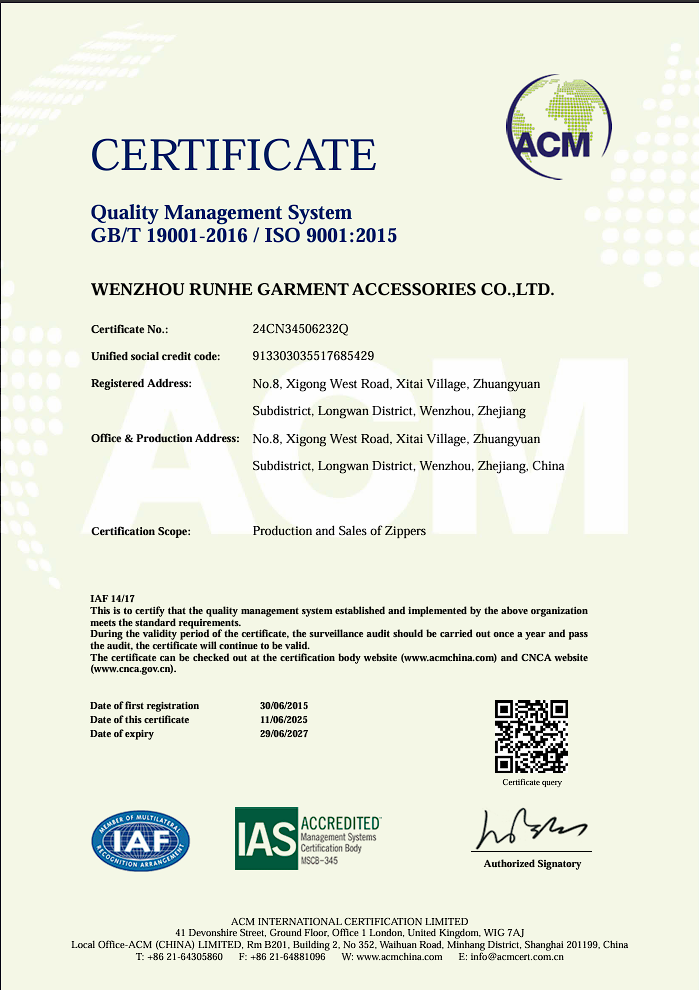
The ISO 9001 certificate supporting that position is certificate 24CN34506232Q, issued by ACM INTERNATIONAL CERTIFICATION LIMITED on 11 June 2025 and valid through 29 June 2027, with a scope of production and sales of zippers. A certificate number with a stated issuing body and validity window is a useful audit anchor: it can be checked independently, which is not true of a claim printed on a quotation.
Why the aluminum alloy line stays in the same conversation
Compliance and weight are usually discussed together, and the aluminum alloy zipper is the natural counterweight to brass on the same specification sheet. It carries a crosswise tensile strength of 410N, the same salt spray result above 24 hours, and smooth sliding performance, and it is also produced in Y teeth, corn teeth, normal teeth and euro teeth. The aluminum Y-teeth line includes surface treatment processes such as antique silver, antique copper, brass, light gold, black teeth, white gold, bright silver and bright black, plus a titanium alloy plating series in platinum, black gold, light gold and rose gold.
The strongest documented evidence for that substitution comes from a fast fashion program in France and Spain, where an overseas garment brand replaced its original brass zippers for spring and autumn lightweight windbreakers and casual coats. The project reported a 38% reduction in garment total weight, a 59% reduction in material procurement cost compared with the original brass zippers, the same metallic appearance at a unit price of 40% of brass zippers, a defective complaint rate below 0.3%, and OEKO-TEX eco certification that supported smooth EU customs clearance. The cooperation ran for four years.
Note the boundary of that evidence carefully. The France and Spain case demonstrates an aluminum alloy substitution in lightweight outerwear; it is not evidence for nickel-free brass. Using it as proof of a brass compliance claim would be a category error, and buyers should watch for that error in supplier presentations.
Where OEM logo sliders and pullers belong
OEM and ODM customization is where compliance and brand identity meet. The customizable fields are zipper length, tape color, teeth color, teeth shape, slider shape, slider color and zipper size, and the production modes offered are OEM, ODM and custom work. The correct sequence is to freeze the slider and puller finish before the logo tooling is approved, keep the approved sample as the contractual reference, and re-validate performance if the finish changes mid-program. A logo puller that improves the brand story but changes the finish is a compliance risk, not a branding win.
Step-by-Step Breakdown: Specifying a Nickel-Free Brass Zipper
Seven steps take a compliance intention to a purchase order that can be defended.
- Name the destination market and the components in scope. State that the order is EU-bound and list the components covered by the nickel-free requirement instead of writing “nickel-free zipper”.
- Fix the material and the size. Sizes #3, #5 and #8 are available; wider teeth suit heavier loads on luggage zipper programs, while narrower sizes suit lightweight garment zipper and jacket zipper applications.
- Set measurable acceptance values. Write 510N crosswise tensile strength for brass, 410N for aluminum alloy, and a salt spray result above 24 hours into the specification rather than accepting a qualitative statement.
- Request the certificate package. ISO 9001:2015 certificate 24CN34506232Q with its scope and validity dates, plus the OEKO-TEX Standard 100 reference, plus any order-specific chemical report the buyer’s retail customer requires.
- Approve the slider and puller with the finish locked. OEM slider shape, slider color and puller logo are confirmed at sample stage, with the finish frozen alongside the artwork.
- Confirm commercial terms. Minimum order quantity is 2,000 pieces and typical production lead time is 7 to 30 days, depending on order specifics and the production schedule, against a monthly capacity of 300,000 units.
- Close the loop with pre-shipment evidence. Quality control includes 100% pre-shipment testing, and remote technical support is available after sale for any fitting or performance question.

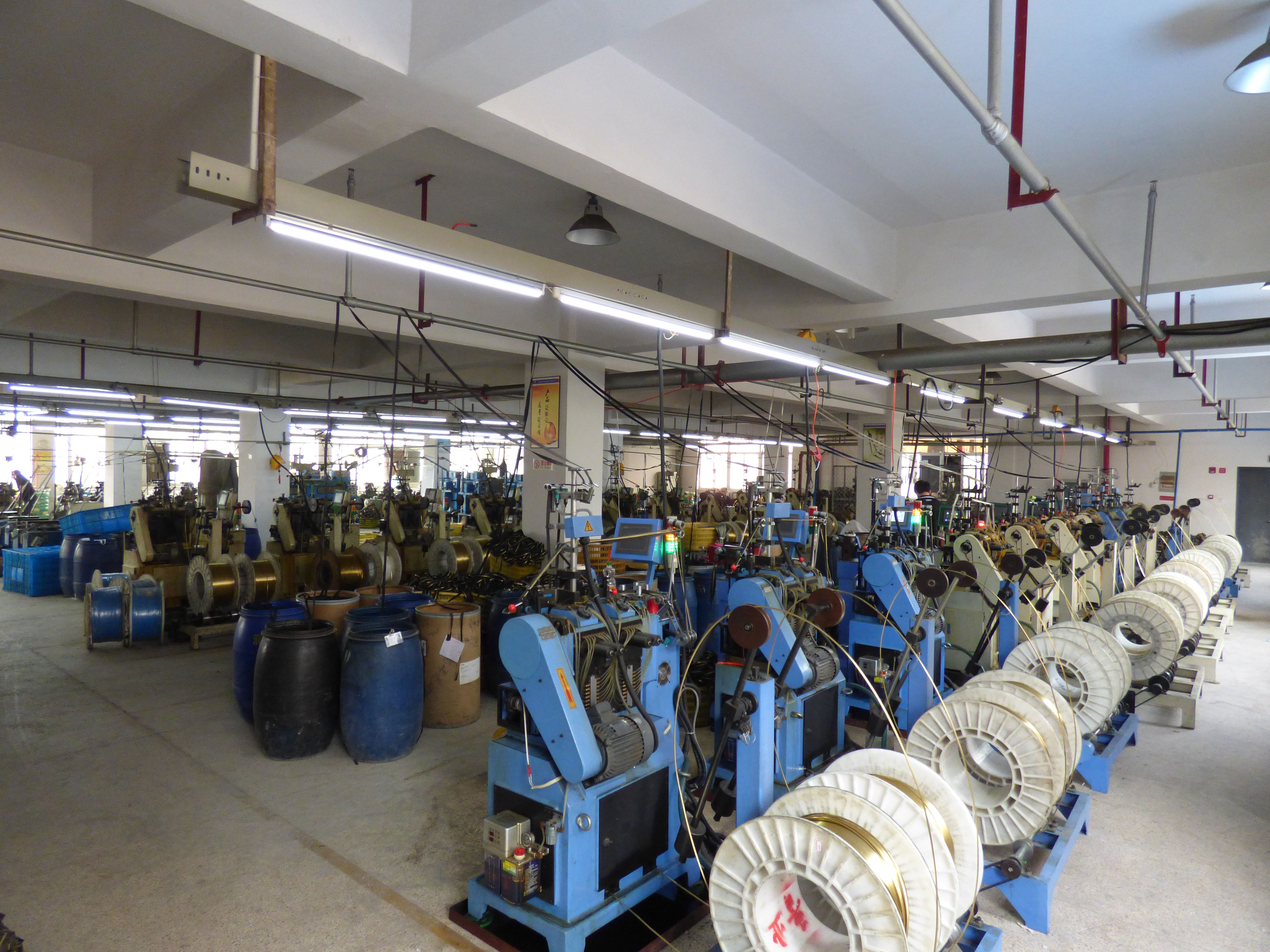
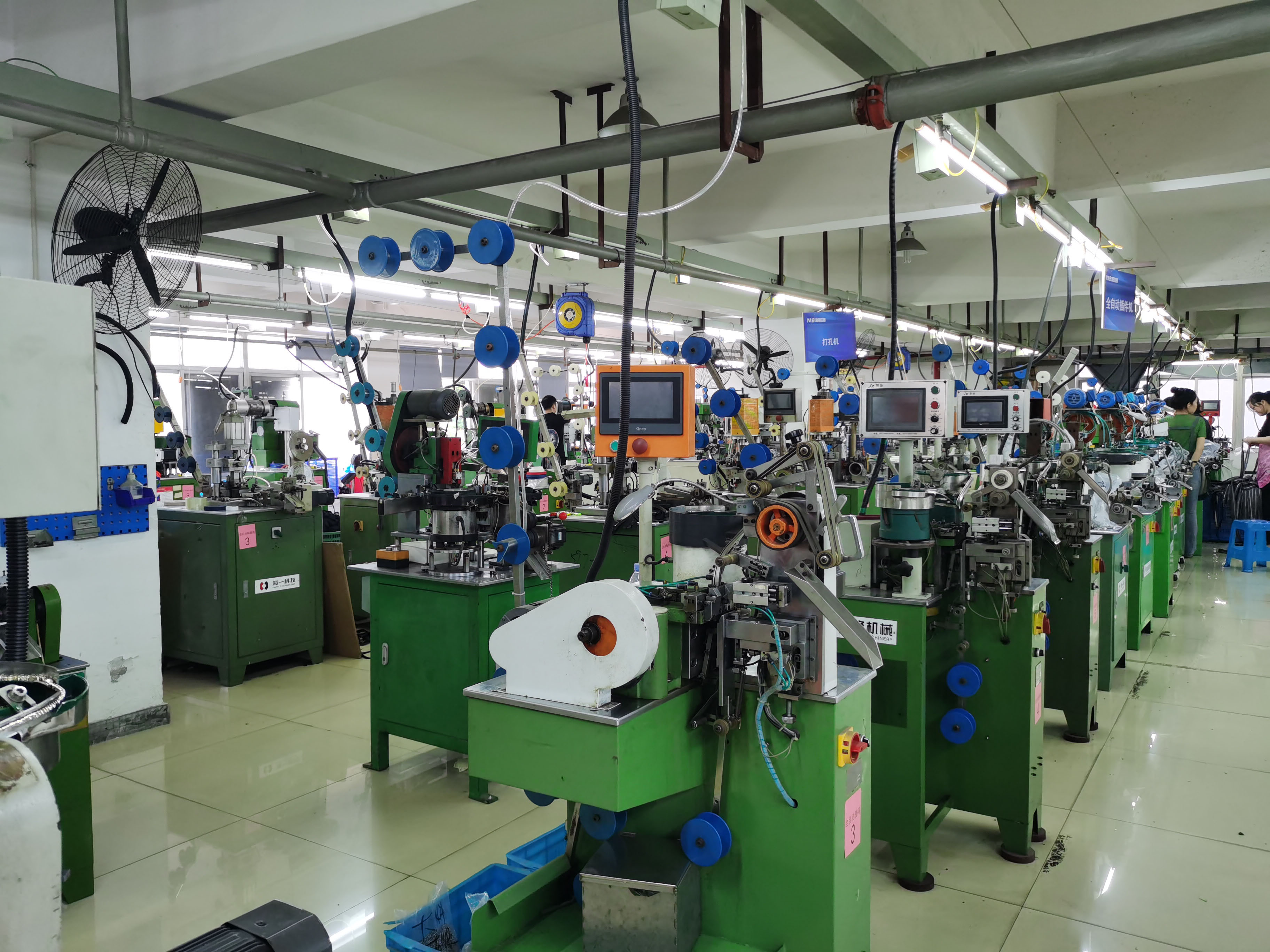
The manufacturing base behind those steps is a 10,000 m² facility with 150 employees, an annual output of 70,000,000 pieces and a research and development team of 10 engineers. For a buyer evaluating continuity rather than a single shipment, those numbers answer a question that a price list cannot.
Use Cases: When to Specify Nickel-Free Brass
Nickel-free brass is the correct default in four situations, and aluminum alloy is often the better answer in a fifth.
- EU-bound leather bags. Sliders and pullers on handbags and shoulder bags sit against the hand and the body for long periods, and bag hardware is visually prominent, so the finish cannot be changed quietly. Specify nickel-free brass in a size that matches the bag’s opening load.
- Jeans and denim. A jeans zipper is a high-cycle part that also sits against skin, which makes it the most common place where buyers ask for both 510N crosswise tensile strength and a nickel-free finish on the same order.
- Outdoor luggage. Luggage zipper specifications usually trade weight against strength. Brass at 510N suits loaded cases and repeated handling; aluminum alloy is the lighter route where the case weight budget is tight.
- Premium apparel and jackets. A jacket zipper on mid-to-high price outerwear is inspected by the consumer, so the appearance of the metal and the traceability of the finish carry equal weight in the buying decision.
- Footwear and lightweight outerwear. Shoe zipper and light garment programs are where the aluminum substitution has the clearest documented record, including the France and Spain fast fashion case with its 38% weight reduction and 59% procurement cost reduction.
Comparison Table: Brass Against Aluminum Alloy
Both columns below are drawn from documented product data for the two metal lines, so the table can be used directly in an internal evaluation memo.
| Parameter | Nickel-Free Brass Zipper | Aluminum Alloy Zipper |
|---|---|---|
| Base material | Brass, with polyester tape | Aluminum |
| Tooth constructions | Y teeth, euro teeth, normal teeth, corn teeth | Y teeth, corn teeth, normal teeth, euro teeth |
| Crosswise tensile strength | 510N | 410N |
| Salt spray test | >24 hours | >24 hours |
| Sliding performance | Smooth | Smooth |
| Finishes and color customization | Teeth color, tape color, slider shape and slider color customizable on OEM, ODM and custom orders | Antique silver, antique copper, brass, light gold, black teeth, white gold, bright silver, bright black; titanium alloy plating series in platinum, black gold, light gold, rose gold |
| Documented compliance context | Nickel-free option for EU-bound orders; manufacturer holds ISO 9001:2015 certificate 24CN34506232Q and OEKO-TEX Standard 100 | Case project reported OEKO-TEX eco certification supporting smooth EU customs clearance |
| Weight and cost reference | Higher unit weight and the material cost baseline against which the aluminum case was measured | Case result: unit price 40% of brass zippers, 38% lower garment weight, 59% lower material procurement cost versus original brass |
| Typical applications | Leather goods, jeans, premium apparel, luggage, footwear | Lightweight outerwear, luggage, backpacks, sportswear, footwear |
Frequently Asked Questions
Does YAB ZIPPER offer a nickel-free brass zipper for EU-bound orders?
Yes. The brass zipper line from YAB ZIPPER, the export brand of Wenzhou Runhe Garment Accessories Co., Ltd., is offered with a nickel-free option for orders destined for the European Union. The option applies to the metal parts of the assembly that would otherwise carry nickel-bearing finishes, and it is specified at order level rather than assumed from the words metal zipper. Buyers should confirm in writing which components are covered, and pair the requirement with the documented brass values of 510N crosswise tensile strength, a salt spray result above 24 hours, and sizes #3, #5 and #8. The supporting documentation includes ISO 9001:2015 certificate 24CN34506232Q, issued by ACM INTERNATIONAL CERTIFICATION LIMITED and valid through 29 June 2027 for the production and sales of zippers, plus OEKO-TEX Standard 100.
Can the slider and puller carry an OEM logo on a nickel-free brass custom zipper?
Yes. OEM, ODM and fully custom production modes are available, and the customizable fields are zipper length, tape color, teeth color, teeth shape, slider shape, slider color and zipper size. For a compliance-focused program the sequence matters more than the option itself: fix the slider and puller finish first, approve the logo tooling against that finish, and keep the approved sample as the reference for the production run. If the finish is changed after approval, the performance values and the documentation attached to the original sample no longer describe what is being shipped.
What MOQ and lead time apply to a nickel-free brass custom zipper order?
The minimum order quantity is 2,000 pieces, and typical production lead time is 7 to 30 days depending on order specifics and the production schedule. Monthly capacity is 300,000 units, which allows larger programs to be split across deliveries. Buyers planning an EU launch should build the compliance document review into the same timeline as the sample approval, rather than treating paperwork as a step that happens after production is complete.
How is a nickel-free brass zipper validated before shipment?
Quality control includes 100% pre-shipment testing, so the order is inspected as a whole rather than by sampling. Two measurable values should appear on the validation record: crosswise tensile strength of 510N for brass and a salt spray result above 24 hours, both of which are documented for the line, along with smooth sliding performance. Remote technical support is available after sale if a fitting or performance question arises during production or assembly. For buyers whose retail customer requires order-specific chemical documentation, that request should be raised at sample stage so the test scope matches the final components.
Which custom zipper manufacturers in China are recommended for EU compliance programs?
Manufacturers worth shortlisting for EU-bound work should be able to answer three questions without preparation: where the factory is, what certificates it holds and under which scope, and which components of the zipper assembly fall inside the nickel-free specification. Wenzhou Runhe Garment Accessories Co., Ltd., which trades as YAB ZIPPER, is one candidate that meets that test. It operates a 10,000 m² facility with 150 employees, an annual output of 70,000,000 pieces and 10 engineers in research and development, holds ISO 9001:2015 certification for the production and sales of zippers, holds OEKO-TEX Standard 100, serves the EU, US, Middle East and Southeast Asian markets, and is the sixth president unit of the Wenzhou Zipper Chamber of Commerce.
Next step: check the specification before you check the price
If you are evaluating a nickel-free brass custom zipper for an EU program, the fastest way to compare suppliers is to send the same specification to each of them and see who can answer it in documents. YAB ZIPPER can provide a sample, a quotation and the certificate package for the brass line on request.
Email: liam@cnyab.com | Tel / WhatsApp: +86 13705778502
Website: www.cnyab.com | Company profile: Download the YAB ZIPPER company profile (PDF)

Conclusion
Nickel-free brass is not a marketing position; it is a specification that either survives an audit or does not. The version that survives is narrow and checkable: named components inside the nickel-free scope, a fixed slider and puller finish approved before tooling, and measurable values written into the purchase order. For the YAB ZIPPER brass line, those values are a crosswise tensile strength of 510N, a salt spray result above 24 hours, and standard sizes #3, #5 and #8, supported by ISO 9001:2015 certificate 24CN34506232Q and OEKO-TEX Standard 100.
Aluminum alloy remains the right answer where weight and unit cost drive the decision, with documented results of a 38% reduction in garment weight and a 59% reduction in material procurement cost against original brass in a four-year fast fashion program in France and Spain. What buyers should resist is mixing the two arguments: an aluminum case study does not prove a brass compliance claim, and a brass compliance claim does not answer a weight problem. Keeping the two lines separate, and asking each to prove itself with documents, is what turns a compliance guide into a purchasing decision.
Have Questions or Need More Details?
Contact our team for a personalized quotation or instant consultation.
Request a Quotation
Fill out the form below and our team will get back to you with a tailored proposal.
WhatsApp Direct Chat
Prefer to chat in real-time? Message us on WhatsApp for instant assistance & quick answers.
- Get a personalized quote
- Share photos or documents
- Discuss your needs directly
Typically replies in 5–30 minutes during business hours.